Unit 11
Entrepreneurship
Activity 1: Look at the picture and answer the questions
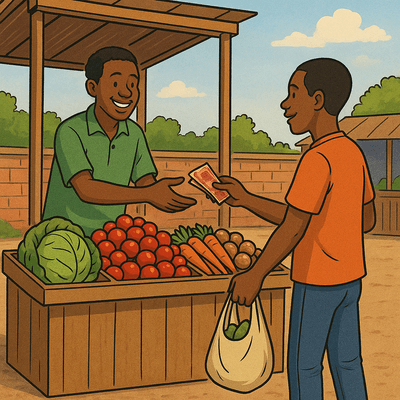
How do you name the roles of the two individuals?
Seller and buyer.
Farmer and carpenter.
What is the business of the seller?
Selling vegetables.
Eating vegetables.
Which vegetables can you see on the table?
Potatoes, carrots, tomatoes, maize.
Tomatoes, carrots, potatoes, cabbage.
What is the buyer giving to the seller?
A bag.
Money.
Why do you think the seller is selling vegetables?
He wants to earn money and run his own business.
He enjoys talking to people.
Activity 2: Learn new vocabulary - match the words on the left side with their meanings on the right side
You found 0 of 13 pairs.
No matches yet
Activity 3: Read and listen to the story - fill in the blanks with the words you hear in the audio
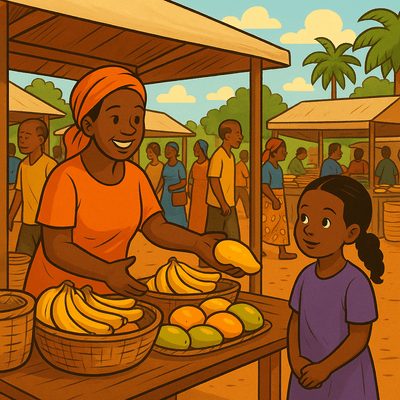
Dorkas lives in a small village. Her aunt is a very smart woman who knows a lot about — how to start small businesses to earn money and help the community. Dorkas often watches her aunt preparing for market day. Her aunt used herto buy the tools andshe needed to start a fruit-selling business at the village market. Every morning, Dorkas’ aunt wakes up early, picks fresh mangoes and bananas, and goes to the . She always smiles and speaks kindly to the customers. Because of her hard work, she makes a goodand saves some money for the future. One day, Dorkas’ aunt had to decide whether to spend her money on new clothes or buy more fruits to sell. She made a smart choiceof her business and bought more fruits. Her success showed Dorkas how important it is to make wise decisions.
Activity 4: Choose the right words from the blue box and write them in the blanks
We will start a school about farming.
My uncle doeswith 30 chickens.
The group votedof selling vegetables.
My sister gave me goodabout saving money.
The school gave usfor our farming project.
Herhelped the business grow.
Everyone canin the group project.
We made aby selling our eggs.
Amust be paid back later.
I keep myin a small box for emergencies.
Activity 5: Listen to the audios and write down what you hear
Activity 6: Learn about relative pronouns
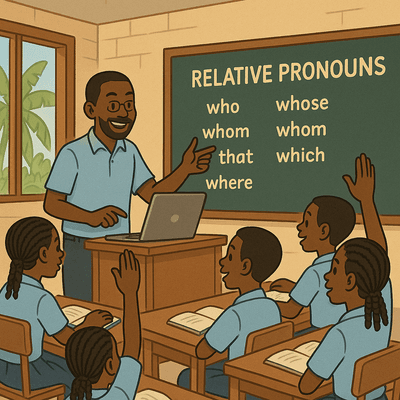
1. What is a relative pronoun?
A relative pronoun is a word that connects two parts of a sentence.
It gives extra information about a person, place, or thing.
2. The most common relative pronouns:
| Relative Pronoun | Use it for... | Example sentence |
|---|---|---|
| who | a person (subject) | The girl who sells tomatoes is my friend. |
| whom | a person (object) – formal | The teacher whom we asked gave us advice. |
| whose | shows possession | That is the boy whose chickens are very healthy. |
| that | people or things (common) | The business that makes soap is doing well. |
| which | things or animals | The coop which we built is strong. |
| where | a place | This is the market where we sell eggs. |
3. Helpful tips
- Use who when the person does something.
The woman who sells vegetables is kind. - Use whose when someone has something.
The boy whose bag is full of carrots is my cousin. - Use that or which for things.
We bought a table that was very cheap. - Use where for places.
This is the farm where we keep chickens.
4. What's the difference between that and which?
✅ That
Use that when the information is important. It tells us which thing we are talking about.
Example: The chicken that lays eggs is in the coop. → (We need this information to know which chicken.)
✅ Which
Use which when the information is just extra. We already know what thing we are talking about.
Example: The chicken, which is brown, is very big. → (We already know the chicken. The colour is just an extra detail.)
→ Easy tip for you:
- Use that for important information.
- Use which for extra details.
→ Don’t worry about “whom” too much!
In everyday English, people often just use who, even when whom would be correct.
So for now: focus on who, whose, that, which, and where.
Activity 6a: Practise using relative pronouns – fill in the blanks with the correct relative pronoun
The girlsells tomatoes at the market is my cousin.
We visited a farmthey keep chickens in a big coop.
We used the moneywe saved to buy more seeds.
A groupmembers work together can grow faster.
The woman the group invited was very kind.
That is the boyproject won the prize.
We built a chicken coopprotects the chickens from rain.
The personyou called is my uncle.
I got advice from a womanstarted her own soap business.
Activity 7: Combine the sentences with the correct relative pronoun
Activity 8: Practise asking questions with relative pronouns
Activity 8a: Choose the correct question for the answer
Rehema will come tomorrow.
Whom will come tomorrow?
Who will come tomorrow?
This is my book.
Who book is this?
Whose book is this?
The blue bag is mine.
Yours bag is which?
Which bag is yours?
Neema is helping at the market.
Who help at the market today?
Who is helping at the market today?
The table near the window is ours.
Which table is for our group?
The table for our group is which?
Fatuma made the presentation.
The presentation made who?
Which pupil made the presentation?
It’s my turn to clean the coop.
Whose turn is it to clean the coop?
Whom is it to clean the coop?
Juma wants to join the project.
The project wants to join who?
Who wants to join the project?
Activity 8b: Write the correct questions for the answers - use who, whose, which, or whom
"" - "David is coming today."
" " - "This is his bag."
"" - "James is helping with our project."
" " - "My favorite fruit is mango."
"" - "Musa helped me with the homework."
"" - "My favorite colour is blue."
Activity 9: Read the story and answer the questions
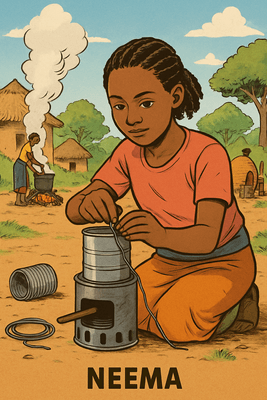
The Business of the Smoke-Free Stove
In a small village in Tanzania, there lived a girl named Neema. Neema was curious and always looking for ways to solve problems in her community. Every day, she watched her family and neighbours cook with wood and charcoal. The smoke from the fire was so thick that it made their eyes burn and their lungs hurt. It was a constant problem in the village, and Neema knew there had to be a better way.
One day, while she was cleaning, Neema found some old cans and metal containers. She had an idea. “What if I could make a stove from these old cans?” she thought. She thought that a stove could produce less smoke if it was built the right way. Neema worked hard, collecting materials. With the cans, some wire, and a bit of wood, she built a small, portable stove. She called it the “smoke-free stove.”
After many tests and improvements, Neema discovered that her stove produced much less smoke than the traditional wood and charcoal stoves. The stove was safer, healthier, and more efficient, and Neema was proud of what she had created.
One day, Neema told her mother about her idea. Her mother was excited and immediately saw that it could be a solution not only for their home but for many other families in the village. Neema decided to show the smoke-free stove to other families. She started organizing small workshops in her village, where she taught people how to build the stove.
The community was excited. Soon, more and more people began using Neema's smoke-free stove. They found that it not only reduced smoke but also used less wood, making it cheaper to cook. Neighbours encouraged Neema to share her idea with other villages.
Over time, Neema’s business grew. She began producing her stoves in larger quantities and selling them at markets in other towns. Neema's business was successful, and she was even able to help other people in her community start their own small businesses. Her invention had not only improved cooking in her village but also changed the lives of many people.
In the end, Neema was not only proud of her smoke-free stove but also of what she had achieved: She had built a successful business and, at the same time, helped improve the environment and the health of people in her community.
What was the main problem Neema wanted to solve?
The loud noise of cooking.
The smoke from cooking with wood and charcoal.
What materials did Neema use to build the smokeless oven?
Old cans, wire, and wood.
Plastic and cloth.
How did Neema’s stove help people in her village?
It produced less smoke and used less wood.
It cooked food faster than traditional stoves.
How did Neema’s business grow?
She started selling stoves in other towns.
She gave away the stoves for free.
What did Neema teach the villagers in her workshops?
How to build the smoke-free stove.
How to make food faster.
How did Neema feel about her invention after it worked?
She was sad because it took too long to build.
She was proud of what she had created.