Unit 3
Everyday matters
Activity 1: Learn new vocabulary - match the words on the left side with their meanings on the right side
You found 0 of 10 pairs.
No matches yet
Activity 2: Choose the right words from the blue box and write them in the blanks
When someone is talking, we listen.
You shouldthe school rules to keep everyone safe.
children help their classmates with homework.
It'sto say "thank you" when someone helps you.
It is notto interrupt when someone is talking.
We must speakto others, even when we are upset.
If your friend makes a mistake, you canthem.
If you break something, you must.
Activity 3: Learn how to use reported speech
1. What is Reported Speech?
We use reported speech to tell what someone said, but not using their exact words.
➡️ Direct speech: Amina said, "I like English."
➡️ Reported speech: Amina said that she liked English.
2. Rules: Change Pronouns and Verb Tense
When reporting speech, we usually:
- Change the pronouns depending on who is speaking and who is being spoken about.
- Shift the tense of the verb one step into the past (this is called backshift).
✅ Start with phrases like: He said that... / She told me that... / They said that...
3. Pronoun Changes (Examples)
| Direct Speech | Reported Speech |
|---|---|
| "I like mangoes," said Aisha. | Aisha said she liked mangoes. |
| "This is my book," said Tom. | Tom said it was his book. |
| "Can you help me?" she asked. | She asked if I could help her. |
4. Verb Tense Changes - Backshift (Examples)
| Direct Speech | Reported Speech |
|---|---|
| am / is | was |
| are | were |
| will | would |
| like | liked |
| play | played |
| have seen | had seen |
| was tired | had been tired |
5. Examples
| Direct speech | Reported speech |
|---|---|
| "I am tired," said Peter. | Peter said that he was tired. |
| "We are playing," said the boys. | The boys said they were playing. |
| "I will come," said Rehema. | Rehema said that she would come. |
| "I like school," said Aisha. | Aisha said she liked school. |
6. Remember:
- We do not use quotation marks in reported speech.
- The word "that" is often used (e.g., "He said that...") – but can be left out in spoken English.
- If the statement is still true or very recent, we don’t always change the tense (e.g. "The sun is hot" → He said the sun is hot).
Activity 4: Change the sentences into reported speech
Activity 5: Listen to the audios and fill in the blanks by writing what Rehema says in reported speech.
Rehema said that her.
Rehema said that she.
Rehema said that.
Rehema said that.
Rehema said.
Rehema said.
Rehema said.
Rehema said.
Activity 6: Read the story and fill in the blanks
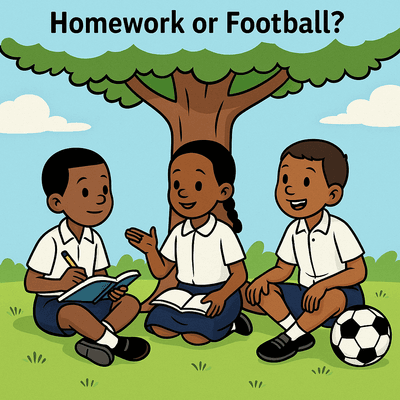
Homework or Football?
It was Friday afternoon, and the sun was shining brightly. After school, three friends – Amani, Juma, and Neema – met at the school gate.
"I want to play football!" said Juma, already holding the ball. "I want to play, too," said Amani, "but we have homework in English." "Homework can wait," said Juma. "Football is more fun!"
Neema shook her head. "I think we should do our homework first."
Juma looked upset. "You never want to play," he said.
"This is not true," said Neema kindly. "But if we play now, we'll be too tired later." "I respect that," said Amani. "Let's do our homework together – then we play!"
Juma sighed, then smiled. "Okay... but only if we really play after!"
The three friends sat under a tree and helped each other with the homework. They asked questions, explained answers, and even laughed a lot.
When they finished, Juma jumped up. "Now it's football time!"
They played until sunset – and everyone felt good, because they had done the right thing first.
After they had finished playing, the three children went home. Neema was so enthusiastic about her experience that she told her family about it at dinner...
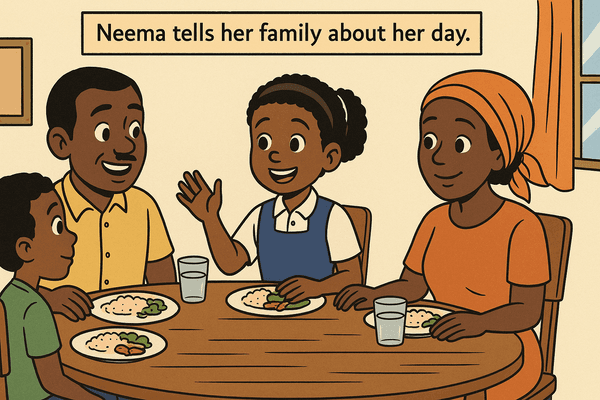
"It was Juma's idea to play football. He said that hefootball. Amani raised some concerns because he said that he, too, but that wehomework in English. I agreed with Amani and therefore said that Iwe should do our homework first. Juma was upset and said that I never wanted to play. So as not to upset him further and convince him, I said in a kindly manner that this. I also explained that if wenow, wetoo tired later. Now, Amani was convinced and said that hethat. And so we did our homework first and then played football. We all had fun and laughed a lot. I wish that every afternoon was like this!"
Activity 7: Learn about punctuation marks
1. Why is punctuation important?
Punctuation helps us understand a sentence.
It shows when to stop, when to pause, when to ask, and when someone speaks.
2. The Most Important Punctuation Marks
Full stop (.)
Use it at the end of a sentence.
Example: I like English.
Comma (,)
Use it to make a pause in a sentence or to separate things in a list.
Examples:
- We read, write, and draw.
- After lunch, we played.
Exclamation mark (!)
Use it to show strong feelings like excitement, surprise, or commands.
Examples:
- What a great day!
- Stop that!
- I love football!
Question mark (?)
Use it at the end of a question.
Examples:
- What is your name?
- Do you like mangoes?
5. Quotation marks (" ")
Use them to show when someone is speaking (direct speech).
Example:
- Rehema said, "I am happy."
The comma goes before the quotation, and the first word inside the quotation marks starts with a capital letter.
Activity 8: Write the sentences from the blue boxes and add the correct punctuation marks
Activity 9: Put the words and punctuation marks from the blue boxes into the correct order
Activity 10: Choose the correct answers
You meet Alena from Germany at 6:18 p.m. How do you greet her?
Good evening
Good morning
What is "saa mbili asubuhi" in English time?
8:00 a.m.
8:00 p.m.
You meet Alena from Germany at 6:18 a.m. How do you greet her?
Good night
Good morning
You will arrive in Arusha at 12:15 a.m., this is...
in the night.
early afternoon.
What does one o'clock mean?
10:00 a.m.
1:00 a.m. and 1:00 p.m.
What is "saa saba mchana" in English time?
1:00 p.m.
7:00 p.m.
We have lunch _______ twelve o'clock.
on
at
Around 7:00 p.m. you eat....
breakfast.
dinner.