Unit 18
Child labour
Activity 1: Look at the picture and answer the questions
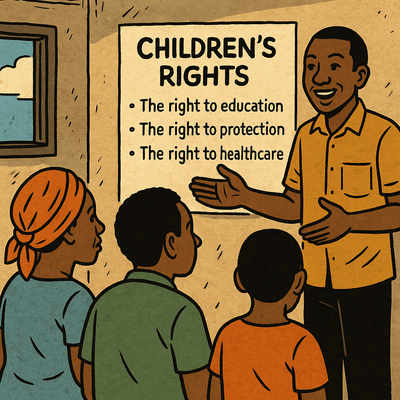
What is the title of the training in the board?
Which of these is NOT a children’s right?
Who is responsible for protecting children's rights?
What does it mean to protect children?
Where can children learn about their rights?
Activity 2: Learn new vocabulary - match the words on the left side with their meanings on the right side
You found 0 of 12 pairs.
No matches yet
Activity 3: Choose the right words from the blue box and write them in the blanks
In a small village, a family was facing many troubles. Their children had to work to support the home. One boy named Robert worked in a where the was very strict. The job was tough and dangerous. Every day, he facedlike dust and sharp tools. Robert had to drop out of school to earn money. The children were paid and it was for them to work at that age. This was a clear case of . One day, Robert had an incident — he tripped over a broken rock and hurt his leg badly. The foreman gave him a coldbut didn’t help him. Fortunately, a children rights visited the area and reported the abuse. People began to talk about the dangers of child labour and how children deserve care and. The community felt pity for Robert and decided to act. Later, the village into two groups — some wanted to keep using children for work, while others believed it must stop immediately. The advocate used strong and steem words to explain why child labour is wrong. Thanks to her efforts, Robert returned to school and got a second chance at a better life.
Activity 4: Read the story and answer the questions
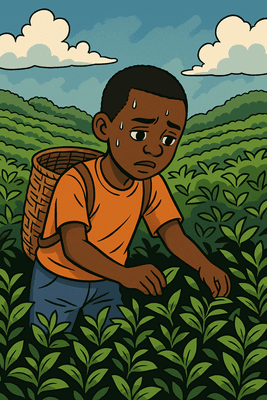
Every Child Deserves Education
In the peaceful village of Rombo, nestled among slopes of mount Kilimanjaro, lived a boy named Juma. Though he was only ten years old, his life was far from peaceful. Every day, Juma worked on a large tea plantation with his uncle.
From sunrise to sunset, he bent over the bushes, picking tea leaves with sore hands. The sun was hot, the baskets were heavy, and his body ached with pain. Juma rarely smiled. He often watched other children walking to school in clean uniforms, laughing and learning. Deep inside, he longed to be one of them.
But Juma's uncle was firm. “We need your help to earn some money,” he said. “Work is more important than school.”
One morning, a visitor came to the village. Her name was Asha, a teacher and children’s rights advocate. She spoke at the village meeting. “Children like Juma should not be working in fields,” she said strongly. “This is child labour. It is illegal, and it is a health hazard. Every child deserves the chance to learn, grow, and dream.”
Juma's mother sat quietly in the crowd. Tears filled her eyes. She realized that while they were trying to earn money, they were stealing Juma's future.
The next day, she made a brave decision. She took Juma by the hand and walked him to Rombo Primary School. Juma was nervous and shy. He had never held a pencil or sat at a desk before.
But teacher Asha welcomed him with a warm smile. “You belong here,” she said. “This is where your future begins.”
In just a few weeks, Juma began to change. He learned to read, to write, and to ask questions. He discovered he was good at math and loved drawing. He made friends who encouraged him, and every day, his smile grew wider. Juma now wakes up every morning with excitement—not to work, but to learn. He dreams of becoming a teacher, just like teacher Asha, to help other children escape the same struggle.
His story became a lesson for the whole village:
“Education is not a gift. It is a right. Every child deserves it.”
Where did Juma live?
What kind of work did Juma do?
Why couldn’t Juma go to school at first?
What did teacher Asha do in the village?
Why did Juma's mother change her mind?
What did Juma discover about himself in school?
What lesson did the village learn from Juma's story?
Activity 5: Choose the correct word from the blue box to fill in the blank
Lifting heavy loads every day can be a seriousto children’s bodies.
The workers were given instructions by thebefore they started picking tea.
Neema a rock while she was carrying a basket.
Baraka was taken to work on a far from his home.
A caring visited the village to help children return to school.
Many children are forced intomissing their chance to learn.
The oldsold vegetables at the market to earn a little money.
Forcing young children to work instead of going to school is
Shouting at and beating children is a kind ofand must be stopped.
Because of the the family remained poor even though they worked every day.
Activity 6: Listen to the audios and write the correct word you hear
Activity 7: Learn about prefixes and suffixes
1. What is a Prefix ?
A prefix is a group of letters added to the beginning of a word to change its meaning.
Example:
- Un + happy = Unhappy (not happy)
- Re + write = Rewrite (write again)
Common Prefixes and Meanings:
| Prefix | Meaning | Example | Meaning of the New Word |
|---|---|---|---|
| un- | not | unfair | not fair |
| re- | again | rebuild | build again |
| dis- | opposite of | disagree | not agree |
| pre- | before | pretest | a test before the main one |
| mis- | wrong/badly | misuse | use in a wrong way |
2. What is a Suffix?
A suffix is a group of letters added to the end of a word to change its meaning or its word type (like from a verb to a noun).
Example:
- Teach + -er = Teacher (a person who teaches)
- Help + -ful = Helpful (full of help)
Common Suffixes and Meanings:
| Suffix | Meaning | Example | New Word Meaning |
|---|---|---|---|
| -er | a person who does something | runner | a person who runs |
| -ful | full of something | joyful | full of joy |
| -less | without something | hopeless | without hope |
| -ness | state of being | kindness | the state of being kind |
| -ly | in a certain way (adverb) | quickly | in a quick way |
Examples from Real Words:
- Illegal Prefix: il- (means not) + legal = Illegal → not allowed by law
- Careless Root: care + Suffix: -less = Careless → without care
- Childish Root: child + Suffix: -ish = Childish → acting like a child
Activity 7a: Choose the correct prefixes and suffixes to fill in the blank
They are going to drown in the water because the sailor of the boat is care.
I had to write my homework after the paper got wet.
My grandmother is very old, but she still has a lot of strength. She is power.
She always understands the instructions.
Malaika is my best friend. The best thing about her is her kind.
The care nurse checked the temperature twice to be sure it was correct.
The shopkeep was kind to all the customers.
She drew a beauti picture of the village.
It iskind to shout at your friends.
The twins oftenagree about games.
Can weplay the music again.
Activity 7b: Choose the correct answer
The prefix “re-” in the word "redo" means:
Which word means “the state of being happy”?
What is the root of the word "disagreement".
Which word means "a person who paints"?
What is the suffix in the word "careless"?
What does the word "dislike" mean?
What does the prefix “mis-” mean in the word “misplace”?
What is the suffix in the word "kindness"?
"My father has no job." - Which of the following suffixes can be attached to the word "job" to describe his job situation?
Which of the following prefixes has negative meaning when used in words?
Activity 7c: Select "true" for correct statements and "false" for wrong statements.
The suffix -er is used to describe a person who does something.
false
true
The suffix -less means "full of."
false
true
In the word "hopeful", the suffix is -ful.
false
true
The word "replay" means to play something again.
true
false
The prefix pre- means "after."
false
true
Activity 8: Learn about nouns, verbs and adjectives
1. Noun – A noun is a name of a person, place, animal, or thing.
Examples:
- Person: teacher, child
- Place: school, Tanzania
- Animal: lion, cow, chicken
- Thing: book, chair, cup
🖊️ In a sentence:
- The boy is reading a book at the school.
- The teacher is writing on the blackboard.
2. Verb – A verb is an action word. It tells what someone is doing.
Examples:
run, eat, sing, jump, write, read, go, come,
🖊️ In a sentence:
- She runs to school every day.
- The children are playing football.
3. Adjective – An adjective is a word that describes a noun. It tells us more about a person or thing.
Examples:
big, small, happy, red, tired, beautiful, ugly, shy
🖊️ In a sentence:
- The small boy is holding a red ball.
- It was a beautiful day.
Activity 8a: Change the verb into a noun using the correct suffix
The president made an important (announce) on the radio.
He made a wise (decide) about school.
The class had a short (discuss) about child labour.
His (perform) at the concert was amazing.
Their (develop) project helped the whole village.
The baby shows good (grow) every month.
Her (arrive) was delayed by the rain.
A good (build) can make a strong house.
Activity 8b: Sort the following words, prefixes and suffixes into the correct category
Verb
Available Items:
Your Selection:
Choose the elements from above
Noun
Available Items:
Your Selection:
Choose the elements from above
Adjective
Available Items:
Your Selection:
Choose the elements from above
Prefixes
Available Items:
Your Selection:
Choose the elements from above
Suffixes
Available Items:
Your Selection:
Choose the elements from above