Unit 20
Hospitality
Activity 1: Look at the picture and answer the questions
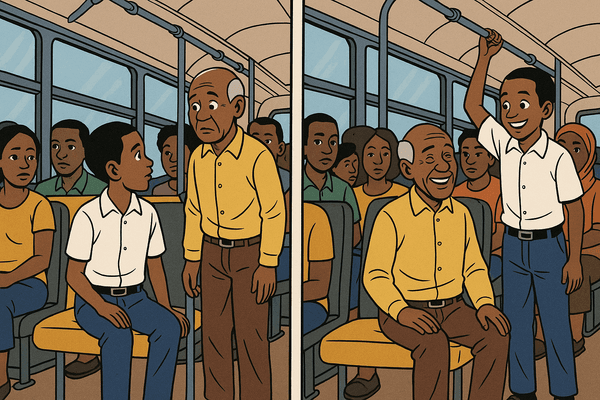
What did the pupil do in the picture?
What value is shown by the student?
Which polite word might the pupil say when offering the seat?
How do you think the old man felt?
What good manner is shown in the picture?
What should you do when you see someone older standing?
What lesson do we learn from this picture?
Activity 2: Learn new vocabulary - match the words on the left side with their meanings on the right side
You found 0 of 15 pairs.
No matches yet
Activity 3: Choose the correct word from the blue box to fill in the blanks
Good makes people feel at home.
I was to see what was inside the box.
Our school is on top of a .
Always usewords like "excuse me."
He opened the door after a short .
The river flows through the.
The bus is at 7 a.m.
I gave the fare to the.
The visitor was happy because the children behaved in a friendly .
The teacher gave a smile to the new pupil.
Activity 4: Listen to the the audios and write down what you hear
Activity 5: Learn polite words and phrases
1. What is Polite Language?
Polite language is the way we speak kindly and respectfully to others. We use polite words to show good manners, respect, and kindness. This is especially important when speaking to teachers, elders, visitors, or anyone we want to treat nicely.
Polite language makes people feel happy, welcome, and respected.
2. Why is Polite Language Important?
- It shows you are well-mannered.
- It helps you make friends easily.
- It makes others feel good around you.
- It avoids hurting people’s feelings.
3. Examples of Polite Words and Phrases
Polite Word/Phrase: When to Use It
- Please: When asking for something
➡ "Please pass me the book."
- Thank you: After receiving something
➡ "Thank you for the gift."
- Excuse me: To get someone's attention
➡ "Excuse me, may I speak?"
- Sorry: When you make a mistake
➡ "I’m sorry for stepping on your foot."
- You’re welcome: After someone says thank you
➡ "You're welcome!"
- May I...: When asking for permission
➡ "May I go outside?"
- Kindly: To sound gentle and respectful
➡ "Kindly wait for your turn."
- Pardon me: When you didn’t hear someone clearly
➡ "Pardon me, can you repeat that?"
💡 Remember:
Speak calmly and respectfully.
Avoid shouting or using rude words like “give me”, “move!”, or “what?”
Always greet people with a smile and say “Good morning”, “Good afternoon,” and "Good evening".
Activity 6: Choose whether the statement is true or false
It is polite to talk when someone else is speaking.
false
true
Saying “thank you” makes others feel appreciated.
true
false
Good manners help us live well with others.
false
true
You should only be polite to people you know.
true
false
Laughing at someone who made a mistake is a kind act.
false
true
Activity 7: Read the story and answer the questions
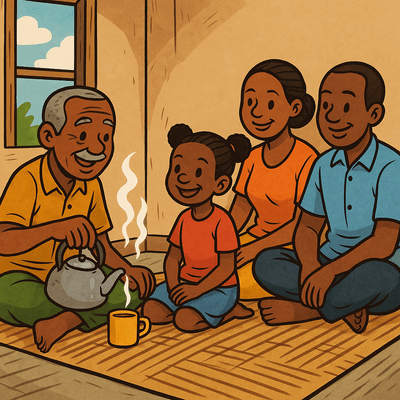
A Visit to Remember
Last Saturday morning, Lucia's family was very busy. They were preparing for a special guest - Grandpa Yohana, who was coming from Kilimani village to visit them.
Mama cleaned the house and made sure the guest room was neat and tidy. Baba went to the market to buy fresh fruits, vegetables, and Grandpa’s favorite mchaichai tea. Lucia helped by dusting the chairs and setting the table.
When Grandpa arrived in the afternoon, everyone rushed to greet him. Lucia ran to open the gate and said, "Welcome, Grandpa! We are happy to see you!"
Baba carried Grandpa's suitcase while Mama gave him a big hug. "Come in and feel at home," she said warmly.
After Grandpa sat down, Lucia brought him a glass of cold juice. Later, she showed him the bathroom to take a shower and the room where he would sleep. They gave him a nice batik blanket that Mama had made. "Here is your room, Grandpa. I hope you like it," she said politely.
In the evening, while Grandpa was having mchaichai tea, they all sat together on the mat and listened to his stories. He told them about life in Kilimani village, the small buildings, and how the places are green with a lot of natural vegetation. Lucia listened carefully and asked questions. They were really excited about Kilimani village, and they promised their grandpa that they would visit him someday. Lucia helped Mama serve the dinner.
Before going to bed, Grandpa said, "You have made me feel so loved and welcome. This is truly a visit to remember." Lucia smiled. She felt proud to be helpful and kind. She had learned that good hospitality means treating visitors with care, respect, and love.
Why was Lucia’s family busy on Saturday morning?
What did Lucia do when Grandpa arrived?
What did Baba do to prepare for Grandpa’s visit?
What did Grandpa like to drink?
What did Lucia and her family give Grandpa to keep him warm?
What did Lucia learn from the visit?
Activity 8: Arrange the sentences so as to make a good composition by giving them letters A - E
36: I take off my uniform, wash my hands, and then eat a snack and rest for a while.
37: Later, I do my homework and have dinner with my family.
38: After school, I walk home with my friends, and I greet my parents politely when I get home.
39: I brush my teeth and go to bed early to get ready for another day.
40: Then, I help my parents with small housework, like watering the garden.
Choose the correct options:
Activity 9: Sort the following words or phrases into the correct categories
Polite
Available Items:
Your Selection:
Choose the elements from above
Impolite
Available Items:
Your Selection:
Choose the elements from above
Activity 10: Choose the correct form of the verb and fill in the blanks
She (wash) her clothes on saturday.
The dog (bark) at strangers.
My brother(read) a book every night.
The bus (arrive) at 7a.m.
We (study) English every day.
It(rain) a lot in April.
I (love) eating ugali.
I(brush) my teeth twice a day.
Activity 11: Change the adjectives into verbs and fill in the blanks
Emilia is strong. Eating ugali(strong) her.
The water is pure. We need to (pure) it before drinking.
The sky is bright. The sun will(bright) it more.
The juice is sweet. They will(sweet) it with sugar.
The cloth is soft. This soap (soft) it more.
The pupils are active. The game will(active) them.
The soup is warm. Please(warm) it fore me.
Her skin is smooth. The cream will(smooth) it.