Unit 2
School academic performance
Activity 1: Learn new vocabulary - match the words on the left side with their meanings on the right side
You found 0 of 20 pairs.
No matches yet
Activity 2: Choose the right words from the blue box and write them in the blanks
helps us stay focused and do our homework on time.
Myis to get an A in English this term.
Please bewhen the teacher is speaking.
If you don’t understand the question,your teacher.
comes when you work hard and believe in yourself.
Your marks are above – good job!
The teacher willthe best group with a sticker.
You have to keep yourif you want to finish your work on time.
Don’t worry about – just try again next time.
Apupil doesn’t give up, even when it’s hard.
Activity 3: Match the pairs - which noun belongs to each adjective?
You found 0 of 12 pairs.
No matches yet
Activity 4: Learn how to compare using adjectives
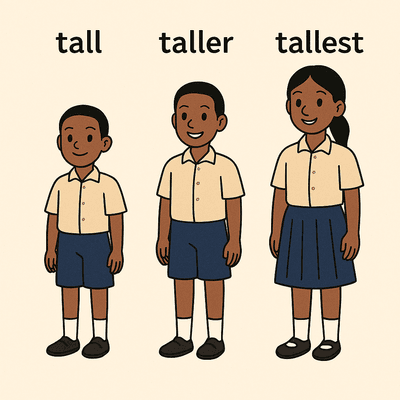
1. What are "Comparative" and "Superlative" Adjectives?
We use adjectives to describe things.
We use comparative adjectives to compare two things.
We use superlative adjectives to say which is the best or most something in a group.
2. The 3 Forms of Adjectives:
| Use | Example with "small" |
|---|---|
| Basic | small (The cat is small.) |
| Comparative | smaller (The mouse is smaller than the cat.) |
| Superlative | smallest (The ant is the smallest.) |
3. Rules to Remember:
🟢 Short adjectives (1 syllable → big, tall, fast):
- Add -er for comparison:
tall → taller - Add -est for the best:
tall → tallest
Example:
- My desk is bigger than yours.
- This is the biggest table in the class.
🟠 Adjectives ending in -y (like happy):
- Change -y to -i, then add -er / -est
happy → happier → happiest
Example:
- I feel happier today.
- She is the happiest student.
🔵 Long adjectives (2+ syllables → careful, intelligent):
- Use more or most:
more careful, most careful
more intelligent, most intelligent
Example:
- Amina is more careful than Peter.
- She is the most intelligent girl in class.
4. Quick Summary:
- If the adjective is short, use -er / -est.
- If the adjective is long, use more / most.
- Always use "than" after comparatives:
👉 He is taller than me.
5. Irregular Adjectives
Be careful: Some irregular adjectives change completely!
| Adjective | Comparative | Superlative |
|---|---|---|
| good | better | best |
| bad | worse | worst |
| far | farther | farthest |
Activity 5: Practise comparing adjectives - fill in the blanks
For example: tall, taller, tallest
smart,,
, faster,
careful, more careful,
,, cleanest
attentive, ,
,, loudest
, better,
happy, happier,
lazy,,
, more difficult,
Activity 6: Choose the right adjectives from the blue box and write them in the blanks
Fatuma is agirl. She always finishes her homework on time.
My bag isthan yours.
She is alwayswith her school books.
Mussa is a fast runner, but Mercy is.
Peter is theboy in our class.
That was thequestion in the exam.
This math test wasthan the one we did last week.
Dorcas is thepupil in our class.
Our classroom is theroom in the whole school.
This term my results arethan last term because I studied more.
Activity 7: Learn about questions: how to ask questions
1. What's special about English questions?
In Swahili, you often ask like this:
➡️ Ulimaliza kazi lini? → “You finished the work when?”
But in English, the question word goes at the beginning!
2. The basic rule:
✅ Question word + helping/auxiliary verb + subject + main verb
Examples:
| Correct English question | |
|---|---|
| You did what? | What did you do? |
| You went where? | Where did you go? |
| You are reading what? | What are you reading? |
| You will come when? | When will you come? |
3. Common question words:
| Word | Meaning | Swahili |
|---|---|---|
| What | for things | nini |
| Where | for places | wapi |
| When | for time | lini |
| Why | for reason | kwa nini |
| Who | for people | nani |
| How | for way/method or feeling | je,/-je |
4. Quick Summary:
- In English, the question word comes first!
👉 What are you doing? – ✅
👉 You are doing what? – ❌
5. Questions with "do / does / did"
- Do you like school?
- Does she have homework?
- Did they finish the test?
Use do/does/did when there is no other helping or auxiliary verb or question word.
Activity 8: Put the words in the correct order to make questions. All words in the blue boxes are small letters - so don’t forget to change the first letter of the first word into a capital!
Activity 9: Write the correct questions to the answers
Activity 10: Read the poem and answer the questions
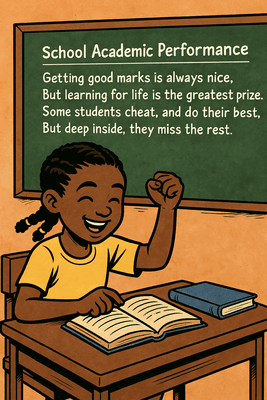
Some pupils race to get the best grade, They chase the marks so they feel great. But numbers don’t tell the whole true tale — It’s honesty and effort that never fail.
A pupil who cheats may pass the test, But deep inside, they miss the rest. For school is not just scores and fame, It’s learning to play life’s honest game.
Real success grows with every try, With helping hands and questions: why? Academic stars shine bold and bright, When they choose to do what’s fair and right.
Activity 10a: Choose the correct answer
What is the main message of the poem?
School is only about exams.
Cheating is sometimes necessary to succeed.
Grades matter, but learning for life matters too.
What is said about cheating in the poem?
It doesn’t help you learn for life.
It helps you pass every time.
It is part of learning.
What does the phrase "But deep inside, they miss the rest" mean?
They passed the exam but didn’t learn for their lives.
They did not finish all their homework.
They failed because they didn’t read the questions.
What does the poem say matters most in learning?
Learning for life and being honest.
Competing with classmates.
Writing fast and finishing first.