Unit 6
Using a dictionary
Activity 1: Read the story and answer the questions
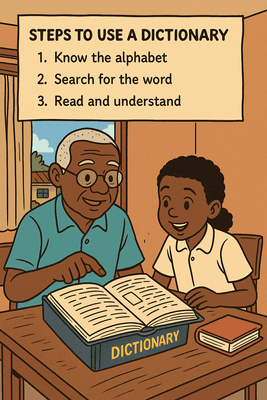
Treasure of Words
Once upon a time in a small village, there was a curious girl named Christina. Christina loved reading books and writing stories in English, but sometimes she found words she didn’t understand. One day, while reading a book about space, she came across a strange word: "orbit."
She ran to her grandfather and asked, “Grandpa, what does orbit mean?”
Her grandfather smiled and handed her a thick book with tiny letters. “This,” he said, “is a dictionary. It’s like a treasure chest. If you learn how to use it, you’ll discover the meaning of any word!”
Christina was excited but confused. “How do I use it?” she asked.
Grandpa said, “Let me teach you in three easy steps.”
Step 1: Know the Alphabet
“First,” Grandpa said, “the dictionary is arranged in A to Z order. So words starting with A come first, then B, then C, and so on.”
Christina nodded. “Like how we arrange names in the register!”
Step 2: Search for the Word
“Let’s look for orbit,” said Grandpa. Christina opened the dictionary and flipped the pages quickly.
“Wait!” said Grandpa, laughing. “Don’t rush. First find the O section. Then look at the second letter — R. Then B, I, and so on. Keep checking each page until you find the word in the right order.”
Christina carefully searched… and finally found it!
Step 3: What can we find in a dictionary?
Each word entry usually shows: The word itself
Example: elephant
- How to say it (pronunciation)
→ example: /ˈɛlɪfənt/ - The part of speech
→ Is it a noun, verb, adjective, etc.? elephant is a noun - The meaning
→ elephant: a very large animal with big ears and a trunk - An example sentence
→ The elephant walked to the river to drink water.
Some dictionaries also show:
- the plural form (e.g. elephants)
- if the word is formal or informal
- different meanings if a word has more than one
Step 4: Read and Understand
Under the word orbit, it said: orbit (noun) – the path one object takes around another, like the Earth orbits the sun.
“Now I understand!” Christina shouted. “Orbit is like a circle path in space!”
Grandpa smiled. “Exactly! You’ve found the treasure — the meaning of the word!”
From that day on, Christina used the dictionary every time she found a new word. She even helped her classmates learn how to use it too. She called it her Word Treasure Book, and soon, the whole class had their own adventures with words!
Moral of the Story: A dictionary helps you find the meaning of new words by looking them up alphabetically, then reading their definitions carefully.
Tips for using a dictionary:
➡️ Always check the alphabet order ➡️ Read the example sentence to understand how the word is used ➡️ Look for similar or opposite words ➡️ Try using the new word in your own sentence
Activity 1a: Choose the correct answer
Why did Christina ask her grandfather for help?
She didn’t know how to write a story.
She found a word she didn’t understand.
She wanted a new book to read.
She was bored and wanted to talk.
What is the first step in using a dictionary?
Learning how to spell long words.
Looking at the picture next to the word.
Reading every page carefully.
Knowing the alphabet order.
What information does the dictionary usually show about a word?
The word, how to say it, what kind of word it is, its meaning, and an example sentence.
The word and its meaning only.
How to spell the word, its meaning, and how often it appears.
The word, its meaning, and who discovered it first.
Why is it important to check the example sentence in a dictionary?
It helps you find the longest word.
It tells you what the word sounds like.
It shows how the word is used correctly in a sentence.
It shows how to write the word correctly.
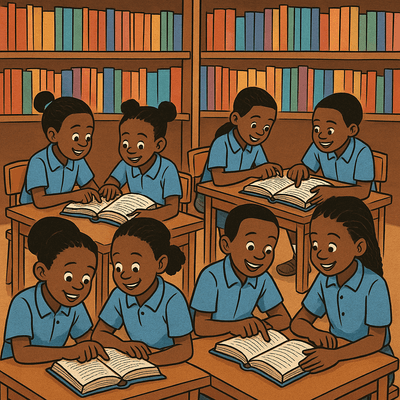
Activity 2: Look at the picture and answer the questions
Activity 3: Learn new vocabulary - match the words on the left side with their meanings on the right side
You found 0 of 10 pairs.
No matches yet
Activity 4: Play the "Guess the word" game
1. Who am I?
- I am a noun and the basic unit of language.
- I start with W and end with D.
- Without me you couldn’t form sentences.
- I’m something you look up in a dictionary.
2. Who am I?
- I am a noun representing a vast body of saltwater.
- I begin with the letter O.
- I cover about three-quarters of the Earth’s surface.
- I am deeper and larger than a sea.
3. Who am I?
- I am a noun and a book full of word entries.
- I start with D and end with Y.
- People consult me to learn pronunciation and definitions.
- I usually have dozens of columns of small, tightly set type.
4. Who am I?
- I am a noun and a place of learning.
- I begin with the letter S.
- Pupils attend me daily to study subjects.
- I often have classrooms, teachers, and homework.
5. Who am I?
- I am a noun and an electronic device.
- I begin with the letter C.
- People rely on me for work, gaming, and communication.
- I rhyme with “scooter.”
6. Who am I?
- I am a noun and a place where goods are exchanged.
- I begin with the letter M.
- Sellers set up stands to sell fresh produce and wares.
- You might visit me weekly for groceries or crafts.
7. Who am I?
- I am a noun and a series of bound pages.
- I begin with the letter B.
- People read me for stories, information, or reference.
- I have a cover, spine, and numbered pages.
8. Who am I?
- I am a noun and a building or room full of books and media.
- I begin with the letter L.
- People can come and borrow books and return the books on time.
- I usually have quiet reading areas and catalog systems
Activity 5: Read the poem and answer the questions
The Magic of the Dictionary
In a book upon my shelf, find the words to help myself. When I don’t know what to say, The dictionary saves the day.
It tells me what the words all mean, From cloudy skies to clothes so clean. It shows me how to spell with care, And find the words that we all share.
Adjectives that make things bright, Like kind and happy, smart and light. Verbs that show what I can do, Like run, write, wash, or tie my shoe.
It puts the words in A to Z, With meanings clear for kids like me. It helps me read, it helps me write, It makes my English sharp and bright!
So when I’m stuck or feeling slow, There’s just one place I always go— My best book friend from A to Z, The dictionary is there for me!
Activity 6: Listen to the audio and write what you hear
Activity 7: Read and listen to the story and fill in the blanks
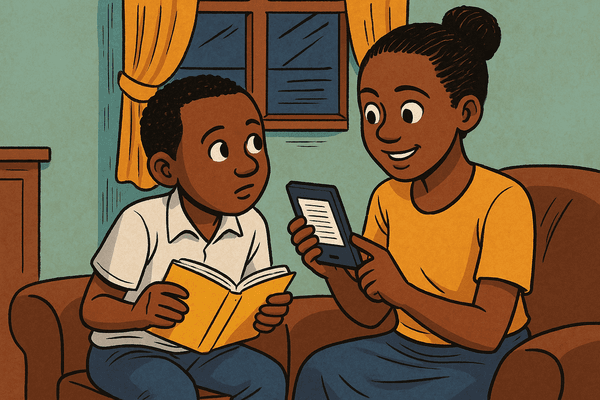
One evening, Amani was reading a short story in. He liked the story, but one word was difficult. He did notwhat it meant. Amani looked around the house. “Where is our?” he asked. But there was none at home. Then he remembered something. “My big sister has a phone with!” he said with a smile. He went to her room and asked, “Can you help me find theof this word?” His sister opened her phone and showed him the word’s. They typed the word into aengine and found the meaning quickly. Amani also saw an example sentence that helped him understand it better. Amani said, “Thank you! Now I understand the story.”