Unit 14
End of the school term
Activity 1: Learn new vocabulary - match the words on the left side with their meanings on the right side
You found 0 of 10 pairs.
No matches yet
Activity 2: Choose the right words from the blue box and write them in the blanks
It was the last day of the school term. Early in the morning, the pupilson the. Everyone was talking and laughing. Some children even began towhen the head teacher came. "We are proud of your hard work," she said. "Today, we will give outto the best pupils." Neema sat next to her friend Asha. They waitedto hear the names. Neema hoped she would win something. Herhad told her, "Even if you don't win, I am proud of you." After the assembly, the teachers went back to theto prepare the prize list. Then, the pupils were called one by one. Neema smiled when her name was called for "Best in English." Later, the head teacher reminded everyone, "Clean your classrooms before you. And remember, bringing your report home is a." Neema felt happy and proud. It was a good end to the school term.
Activity 3: Listen to the audios and write down what you hear
Activity 4: Read the story and answer the questions
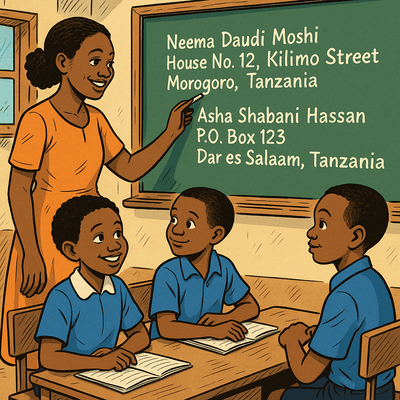
Where Do You Live? – A Story About Addresses
One day, the teacher asked the class, "Can you write a formal letter to your parents?"
Neema raised her hand. "Yes, teacher! But… where do I send it?"
The teacher smiled. "Good question, Neema. To send a letter, you need an address."
The class looked confused. "What is an address?" Asha asked.
"Well," the teacher explained, "an address tells the post office where the letter should go. It helps the letter find the right person."
She wrote on the board:
What is an address? An address is a place where someone lives or receives letters. It usually includes:
- The name of the person
- The house number (if there is one)
- The street name (if the street has a name)
- The area or neighborhood
- The town or city
- The postcode (called postal code – a number for the area)
The teacher continued: "In some countries, every house has a number and every street has a name. But here in Tanzania, not all streets have names, and many houses have no numbers."
"So how do people get letters?" Baraka asked.
"Good question," said the teacher. "That's why many people use a P.O. Box."
She added:
What is a P.O. Box? It means Post Office Box. It is a small locked box at the post office. If you don't have a home address, you can collect your letters there.
She gave two examples:
Example 1 – Home Address: Catherine Daudi Moshi House No. 12, Kilimo Street Morogoro Tanzania
Example 2 – P.O. Box: Asha Shabani Hassan P.O. Box 123 Dar es Salaam Tanzania
Neema smiled. "Now I understand!"
That afternoon, she went home and asked her mother, "What is our address?" Her mother said, "We use P.O. Box 88, Morogoro." Neema wrote it down carefully.
Now she could write her letter — and knew exactly where to send it!
Activity 4a: Answer the questions
Activity 5: Learn the parts of a formal letter - match the words on the left side with their meanings on the right side
You found 0 of 10 pairs.
No matches yet
Activity 6: Find the parts of a formal letter in the pictures
Where is the date?
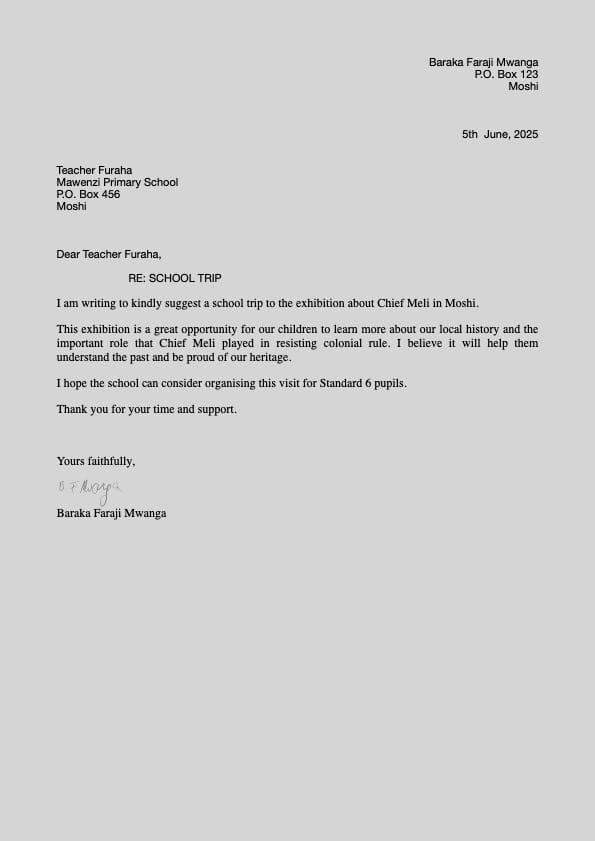
Where is the sender's address?
Where is the body of the letter?
Where is the heading?
Where is the receiver's address?
Where is the signature?
Where is the salutation?
Activity 7: Sort the phrases into the correct parts of a formal letter
address
Available Items:
Your Selection:
Choose the elements from above
date
Available Items:
Your Selection:
Choose the elements from above
salutation
Available Items:
Your Selection:
Choose the elements from above
heading
Available Items:
Your Selection:
Choose the elements from above
body
Available Items:
Your Selection:
Choose the elements from above
ending
Available Items:
Your Selection:
Choose the elements from above
sender's name and signature
Available Items:
Your Selection:
Choose the elements from above
Activity 8a: Arrange the parts of a formal letter in the correct order by filling in the blanks
1:
2:
3:
4:
5:
6:
Activity8b: Arrange the parts of a formal letter in the correct order by filling in the blanks
1:
2:
3:
4:
5:
6:
Activity 9: Choose the correct answer
Where do you write the sender’s name?
Where do you write the date in a formal letter?
Where do you usually write the "RE:" or subject line?
Which parts of a formal letter are on the right side?
Where do you write the receiver’s address?
Which is the correct way to write the greeting in a formal letter?
Which is the correct way to write the date?
Activity 10: Read and listen to the story and answer the questions
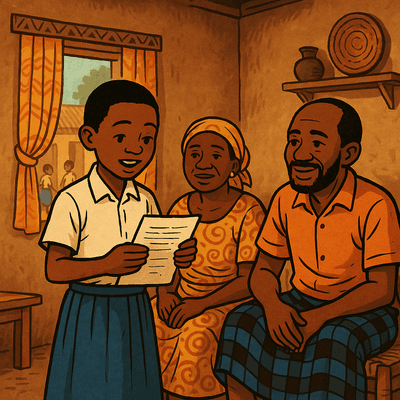
Fatuma is a Standard 5 pupil at Jitegemee Primary School in Tanzania. It is the last day of the school year. After school, she walks home with her school bag and a big smile on her face.
When she arrives home, her parents are sitting outside.
"Mama, Baba!" Fatuma says. "I have a letter from the head teacher!"
Her parents stop what they are doing and listen carefully. Fatuma opens the envelope, stands up straight, and begins to read the letter aloud:
Who is the letter for?
Parents or pupils
Parents or guardians
What is the letter about?
End of term information
Mid-term information
What are the attachments to the letter?
The child's results and school information
The child's report and the list with the exact details of the necessary items
What are the necessary items the pupils must bring?
Paper, books, marker pens, money, and comfortable clothes
Exercise books, text books, school uniform, school bag, pens and pencils, and sports jersey